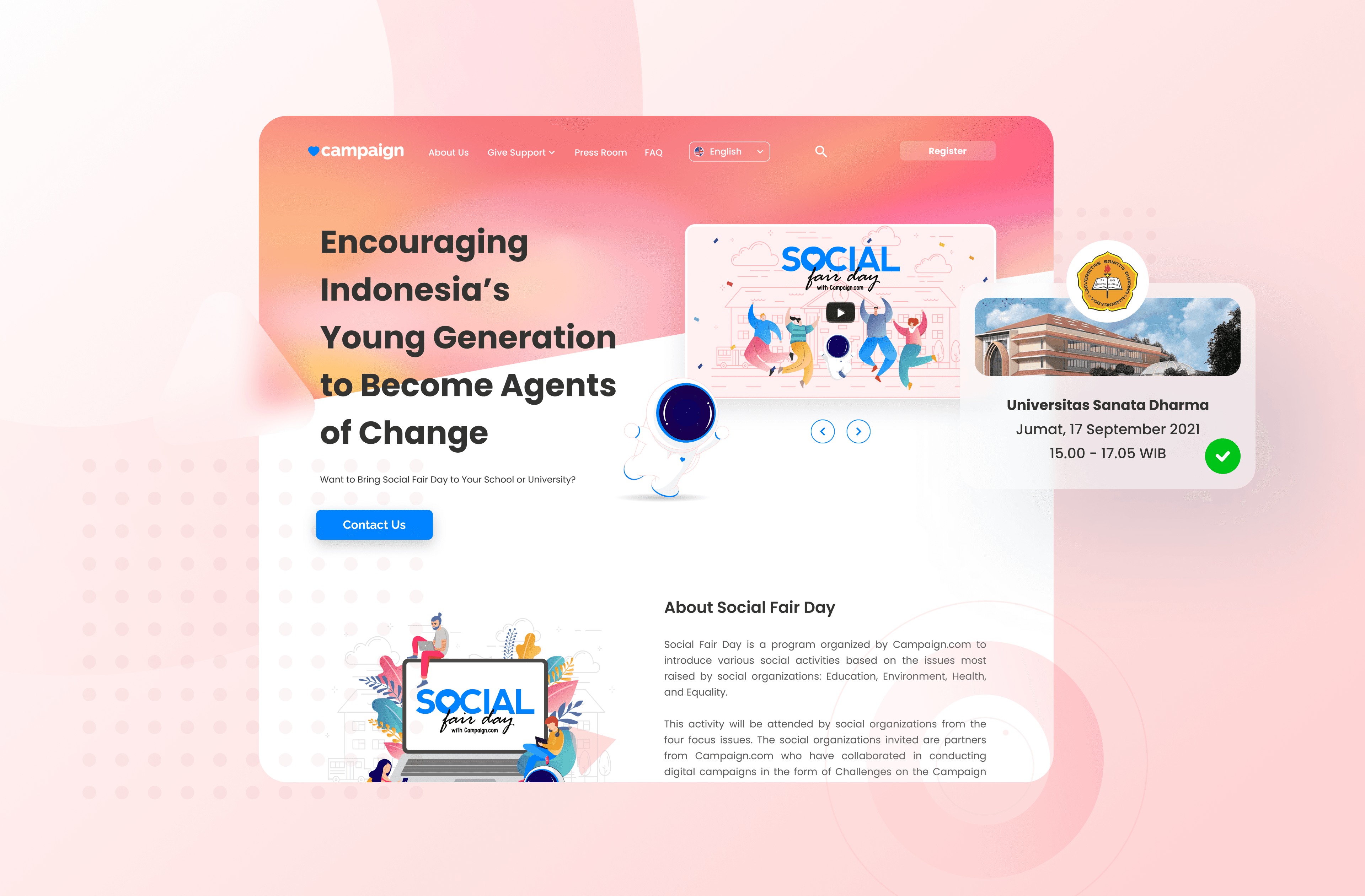
A UX & Content Strategy That Enabled Campaign.com to Enter the US Market
Work Project
Campaign.com is a mission-driven platform where users take social actions to unlock donations from sponsors. After success in Indonesia, the company set its next milestone: to enter the United States.
But there was one major blocker — for US-based users, organizers, or sponsors, there was no dedicated website explaining what Campaign is, how it works, and why it matters. Without clarity and credibility, scaling globally would be nearly impossible.
[My Role]
UX Designer
UX Researcher
[Timeline]
October 2021
The challenge
Campaign’s value proposition is inherently complex:
Organizers → create campaigns.
Supporters → join campaign action from Organizers
Sponsors → convert action from supporters into donations
This ecosystem was quite intuitive in Indonesia (brand familiarity), but completely unknown in the US. Without research, buyer psychology, or localized messaging, the risk was high:
"If new users don't instantly understand the concept, adoption stops before it begins."
Design approach
Step 1: Define what the US audience needs to understand FIRST
When entering the site for the first 10–15 seconds, we needed users to instantly understand three things or otherwise they would bounce:
Why Campaign.com exists
This hierarchy became the backbone of the homepage. Anything that didn’t serve these three questions was deprioritized.
Result of Step 1: users get the concept before they explore the product, not after they get lost in it.
Step 2: Turn an abstract concept into a sharp narrative
The original message was too corporate and assumed the audience already knew the brand. So instead of listing features, we structured the content to answer the questions humans naturally ask:
"Who is this platform for?"
"Why does it matter?"
"What problem does it solve?"
"What action should I take next?"
Result of Step 2: the brand becomes relatable, not abstract, not idealistic, but relevant to real people.
Step 3: Design pages that sell through understanding (not persuasion)
Every page was built with a single conversion goal, so users always know what to do next.
Instead of pushing users to sign up immediately, we let clarity do the heavy lifting.
Result of Step 3: the website informs → aligns values → then converts. No hard sell needed.
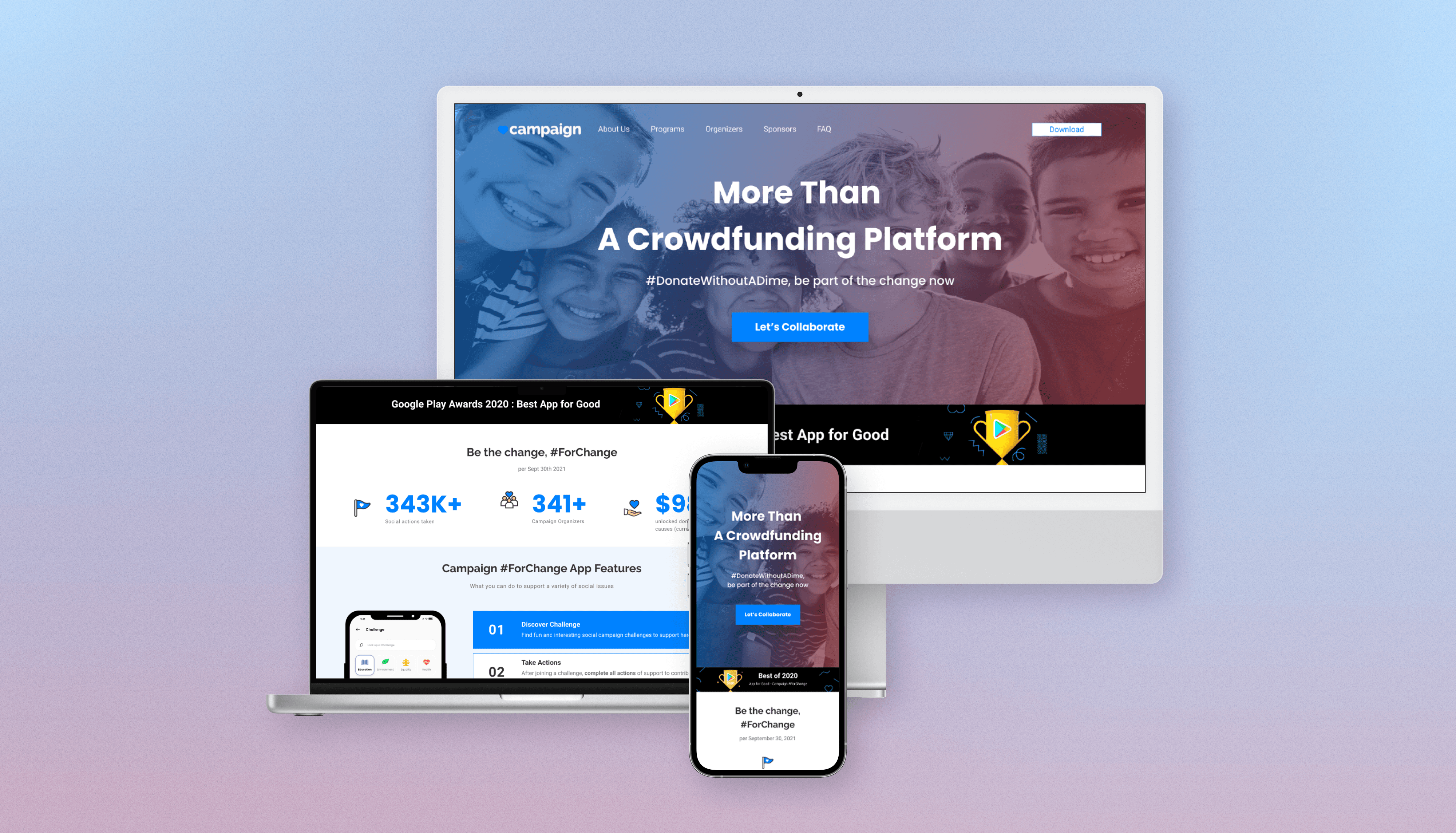
Final design highlights
HOMEPAGE — Social proof + impact + app context in under 10 seconds
ABOUT — Mission → values → ecosystem → journey
ORGANIZER PAGE — Benefits + onboarding steps + testimonials
SPONSOR PAGE — Credibility drivers + call-to-contact
PROGRAMS PAGE — Real-world US activities to prove legitimacy
Impact
Although the website had not undergone full usability testing yet, early signals from internal stakeholders and first-wave US users suggested meaningful progress toward the expansion goal:
Sales & partnership teams finally had a single source of truth to send to US organizers and sponsors
New users no longer needed a call to “understand Campaign” because the website clarified the value proposition in seconds, not minutes
The onboarding funnel to “Organizer” and “Ambassador Programs” showed higher engagement, driven by clearer narrative and benefit communication.
Reflection:
Designing for global expansion without formal research taught me an important reminder: When the audience changes, the narrative must change too.
Strong UI doesn’t matter if the message doesn’t land. This project sharpened my understanding that UX isn’t only about usability, it’s about making meaning transferable across markets, cultures, and motivations.
[other projects]
[UI Gallery]